Nextflow is the most widely adopted workflow engine in life sciences. Claude is the most capable AI for scientific reasoning. Together, it closes the loop on AI-assisted discovery and execution.
February 19, 2026A multi-omics drug discovery pipeline can involve sequencing data generation, quality control, variant calling across thousands of samples, gene expression analysis, protein structure prediction, pathway enrichment, and integration with clinical trial data for machine learning. Each step has dozens of configuration parameters, and scientists spend weeks developing and troubleshooting when workflows fail or produce unexpected results.
Nextflow was created by the founders of Seqera in 2014. It has become the dominant technology for bioinformatics and computational biology. Daily workflow runs have grown from ~20K in early 2024 to regularly exceeding 100K.
Anthropic recently launched the Nextflow Development Skill as part of the Claude for Life Sciences initiative. It enables bench scientists to run omics analyses without specialized bioinformatics training, but is currently limited to local execution of a subset of nf-core pipelines. The opportunity is enterprise scale, regulated environments, and full traceability.
BioPipelineBench assesses AI's ability to execute bioinformatics workflows spanning targeted and long-read sequence analysis, metagenome assembly, and chromatin profiling. The rate of improvement signals practical viability.
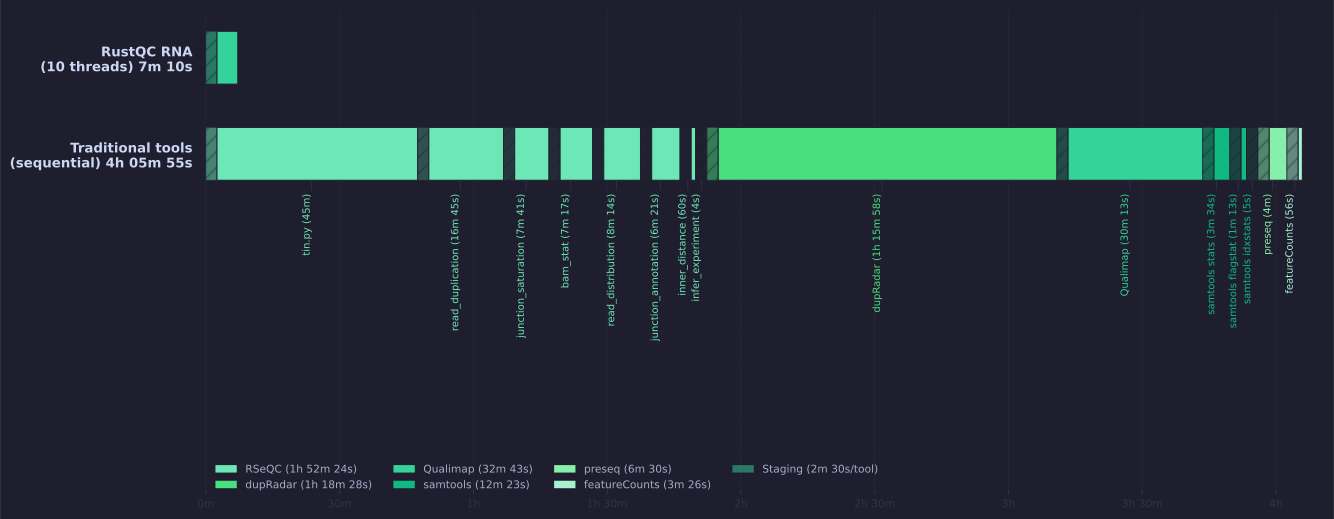
In the last 7 days, Seqera has used Claude Code and Opus 4.6 to rewrite fundamental pipelines for biology, including RustQC, a next-generation quality control pipeline built from the ground up. Remarkably, we were able to achieve a 21x performance improvement.
Seqera is using AI agents to massively parallelize workflow optimizations. Agents systematically explore the configuration space of bioinformatics workflows, delivering superior scientific results and generating higher-quality training data for bioML models.